Living under watch: checkpoints, two phones, and the draft
What daily life looks like under military checkpoints in Yangon and Mandalay: phone searches, two digital identities, tracked payments, and mandatory service.
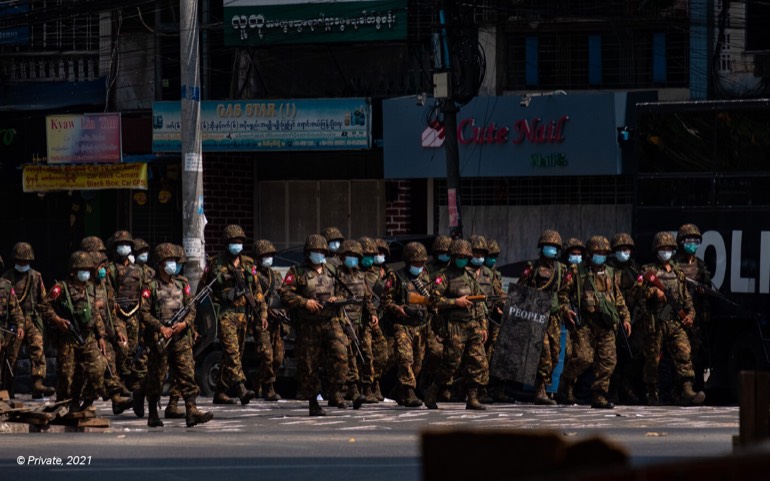
The checkpoints
When the military began setting up checkpoints at random, everything about going outside changed. Walk out with friends, day or night, and you could be stopped. The questions were never really about where you were going. They were about what you'd shared, what you'd said, and whether you had any connection to the National Unity Government (NUG). Any trace of contact with it is illegal. Depending on your background, and depending on money, getting caught with anything tied to a "freedom post" carries an automatic three-year jail sentence.
Checkpoints aren't limited to the roads between cities; they happen inside the cities too. In Yangon, roughly 90 percent of people rely on public transportation, walking from stop to stop, which makes them easy to catch. Adults and young adults are the main targets.
One woman's story
One case people still talk about involves a woman, 47 years old, who had worked at the post office under the previous government. She'd taken part in the Civil Disobedience Movement (CDM). In 2022, on an ordinary day, she was out on a lawn and took a photo, not of anything political, just a plant, a flower. A group of soldiers passed by and assumed she was photographing them.
They stopped her and checked her phone. She didn't know how to delete anything, so the soldiers found everything, including evidence of her involvement in the CDM. That was enough for an automatic three-year sentence. The military told her to go to the capital, apologize, and offer something, a bribe, a gift, and in exchange her sentence stayed at three years instead of something worse.
Conditions inside were brutal: bad food, bad water, no real rights, treated as lesser. Her family was allowed to visit once a month, and any money sent to her was skimmed before it reached her; the jail always took its cut. Some of the women who served time alongside her were raped, or killed by beating or stabbing.
When she was finally released, her family said she came out a different person, scared and traumatized. She'd forgotten how to do things she'd always known how to do: driving, using a phone, using a computer.
Two digital identities
At the checkpoints, the military looks for anything that ties a person to the opposition or to anti-regime sentiment online. If they find it, they don't let it go. Because of this, most people now keep two or more social media accounts, and this extends beyond social media to email and Apple IDs, essentially every digital identity a person holds.
One account is the real one: real name, real face, everything. The other exists purely to show the military if stopped, and increasingly even that fake account has to carry a real name, because the soldiers have gotten better at spotting fakes. This has been the reality for four to five years now: living with two digital identities under constant pressure.
Facebook, Instagram, and X are illegal to use without a VPN; the military banned them outright. If soldiers find those apps on your phone, they can send you to jail immediately, no further questions asked. It's handled case by case. Computers and iPads tend not to get checked as closely, so a lot of people keep anything sensitive stored there instead of on their phones.
Following the money
KBZPay, the local equivalent of Thailand's PromptPay, is now being watched too. Every transaction is tracked, largely to make sure money isn't flowing to the new government.
The new smart ID card ties into all of this. It's a national registration system, and once someone registers, the authorities have already collected the data they need. From that registry, the military is calling up anyone over 18 for mandatory service: men from 18 to 45, women from 18 to 28, two years of service required. If the country is declared to be under emergency, the age range for men can extend to anyone under 45 who's able-bodied, in effect, almost everyone.
Families with money can pay to keep their children out of service. But the military still has a fixed quota to fill, so for every person who buys their way out, someone else, often picked at random, is pulled in to take their place.
Different cities, same pressure
In Yangon, heavy reliance on public transport makes people easy to catch. In Mandalay, most people ride motorcycles, and there are more than ten checkpoints across the city; soldiers can search motorcycle compartments and car interiors for anything they consider suspicious. Between the two cities, there's effectively no privacy and no real freedom of movement.
Passports, papers, and the ones who don't come back
Myanmar currently issues five types of passports: PV (visit), PJ (job, permission to work abroad), OWIC, PE (education), and the green book, a government-sponsored passport. Just applying to go abroad shows how narrow the path is. To get a PJ passport, applicants first need an OWIC card. And if immigration officials assess an applicant as able-bodied, they may be pulled into service instead, even when the person's only goal was to work overseas.
Because of this, most people now go through agencies to leave the country. At immigration, they're asked directly whether they've completed their military service. If the answer is no, they're sent to complete it before they're allowed to leave.
Very few of those men come back. Most who serve die in service, and when they do, the military doesn't notify anyone, not even their families. Beatings happen inside the jails and during the process of being taken in, sometimes before the men even reach a military camp; some are beaten to death at police stations before deployment even begins. Afterward, the military tells the family to come collect the body, claiming an accident. The families understand exactly what happened. There's nothing they can do about it.
Note: This is one person's account, based on lived experience and family history. For broader context, look into the Politics of Myanmar.