One person's account of the Myanmar coup
A first-hand account of the 1 February 2021 military coup in Myanmar: how it unfolded, the Civil Disobedience Movement it sparked, and the resistance that followed.
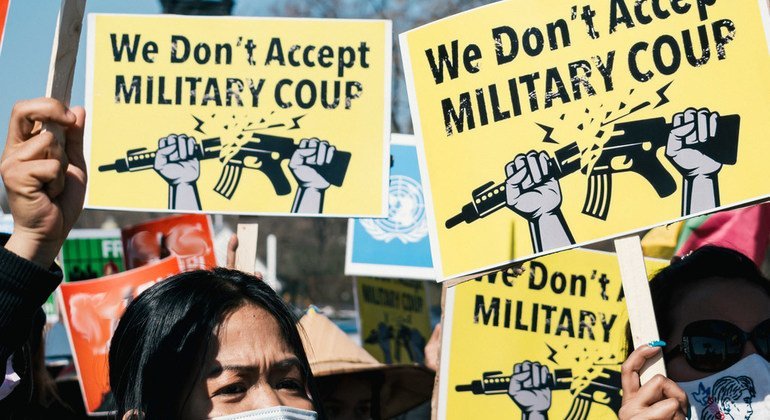
It happened at two or three in the morning on 1 February 2021. The military moved while the country slept, and by six a.m. everyone woke up cut off. No internet, no data. Electricity was still on. SMS still worked, oddly enough, but you couldn't call anyone in the provinces. Aung San Suu Kyi, the state counsellor, and President Win Myint had already been detained. The military came on and said the country was under their control now. It wasn't a coincidence, either. That was the exact day parliament was supposed to meet for the first time since the election.
Their excuse was that the election the year before had been stolen from them, that the NLD had won illegally. Which, of course, wasn't true. But that was the story. For a lot of people my age, it didn't feel real. It's 2021, this doesn't happen anymore, right? The older generation didn't feel that way at all. A lot of them figured the top leaders probably knew something like this was coming.
This had happened before
Watching it unfold from Mandalay, the second biggest city after Yangon, didn't feel shocking so much as familiar, at least to my mother. She'd lived through this once already. The military first took over back in 1962, when General Ne Win pushed out the civilian government, and then again in 1988. Same institution, different decade.
The '88 uprising actually started over something small, a fight at a tea shop involving an engineering student, and it just snowballed from there into what people now call the 8888 Uprising. University students were at the center of it, and the military used that later as one of their justifications for cracking down on students for years afterward.
Even back in 1962 the reasoning was thin. The military basically said the civilian government couldn't hold the country together, so they had to step in.
What stayed consistent across all of it was where the fighting happened. Yangon and Mandalay stayed relatively calm. The provinces didn't. Bombing, fighting, general chaos: that was just normal life outside the big cities, going back to the early 60s. Censorship and propaganda came with it.
This time around, the older generation kept saying the same thing: don't let this turn into what happened before.
The first few days
On the first of February itself, nobody really did anything. Everyone was just quiet. It took two or three days before someone in Mandalay actually stood up and said, out loud, that he didn't accept what the military had done.
That morning, once word got around that the state counsellor had been taken, it felt like the whole country was being dragged back into a nightmare it thought it had already escaped. People were basically stuck between two options. Stay quiet for a week and hope things went back to normal on their own. Or do something in that window, because if nobody said anything, the rest of the world might just assume everyone had accepted it.
The guy who broke the silence was in his thirties, most likely Dr. Tayzar San, a physician from Mandalay who led the city's first anti-coup protest on 4 February, three days after the coup, in front of the University of Medicine. He's still alive today, though he's spent most of the years since in hiding after the junta put a bounty on him. His speech spread everywhere online, and it seemed to give everyone else permission to say what they'd been afraid to say.
That's when people started organizing in their own circles: doctors and nurses, teachers, university students. This became the Civil Disobedience Movement, or CDM. The idea behind it was simple: if you kept working for the government after this, you were basically saying you accepted it. So people quit. En masse. That was the protest.
The timing made it worse, too. This was maybe a couple weeks after the country had started climbing out of COVID. People hadn't even caught their breath yet. That first month after 1 February was basically the CDM taking over everything.
When it didn't just go away
The military seemed to be banking on history repeating itself. In '88 and '89, the protests fizzled out after a few months. This time it didn't happen that way.
People were posting everywhere, tagging the world, asking for help. Nobody came. The message everyone kept getting back, more or less, was "it's your country, you deal with it." But people didn't stop.
When peaceful protests started, the military started beating people they couldn't control any other way. Within about a week after that, kids were dying, some targeted, some just caught by stray bullets. By that point the only people who weren't part of the movement were the ones who were already tied to the military somehow.
By around the one-year mark, most people had stopped going out to protest in the streets. Not because they gave up, but because they'd figured out that shouting in the street wasn't stopping anything, and it was getting people killed. Some kept doing it anyway. Some of them died for it. But the resistance itself didn't end. It just changed form.
From the streets to the jungle
Most of the people involved were young and had zero fighting experience. But the conclusion a lot of them came to was that marching wasn't going to cut it anymore. It had to be an eye for an eye, force for force.
So people started heading out to the border areas, where ethnic armed groups had already been fighting the central government for decades, in some cases longer than the 1962 coup itself. CDM members and others left the cities for these regions specifically to learn how to actually fight, from groups that had generations of experience doing exactly that against this same military.
Naypyidaw, meanwhile, stayed the seat of power, the capital the military built for itself.
Where it stands now
Two things are happening at once now. Some people left the country entirely and are in bigger Western countries trying to get the word out: that this military government isn't legitimate, that it's not really the country's government at all. Others stayed and went into the jungle to fight, alongside the ethnic armed groups that have been at this for decades.
Both sides are working toward the same thing: a real government to replace this one. That effort has a name now: the National Unity Government, made up of ousted lawmakers and pro-democracy figures who refused to accept what happened.
Note: This is one person's account, based on lived experience and family history. For broader context, look into the Politics of Myanmar and the National Unity Government.