The squeeze: how Myanmar's junta is closing every exit
A troop deal in Moscow, a passport rule that pulls people back across the border, and a banking lockdown that traps the money. Three moves in ten days, and the distraction running underneath them.
A deal in Moscow
On 18 August 2026, Myanmar's junta leader flew to Moscow to meet with Russian officials. It wasn't the first sign of this relationship. Men from Myanmar have already been sent to Russia for military training, and the junta has shown time and again that it moves when Putin asks. It's a pattern that's been building quietly for years, mostly out of the spotlight that usually falls on Myanmar's internal conflict. This time, though, the request on the table was reportedly bigger than anything before it: 50,000 Burmese troops to fight in Ukraine.
Fifty thousand isn't a small number. For a military already struggling to hold territory against resistance forces at home, pulling that many men from its own ranks should be impossible, unless the plan was never to pull them from an already-stretched army, but to go find them elsewhere.
What happened in the days that followed suggests the deal didn't stay in Moscow. It came home.
The passport trap
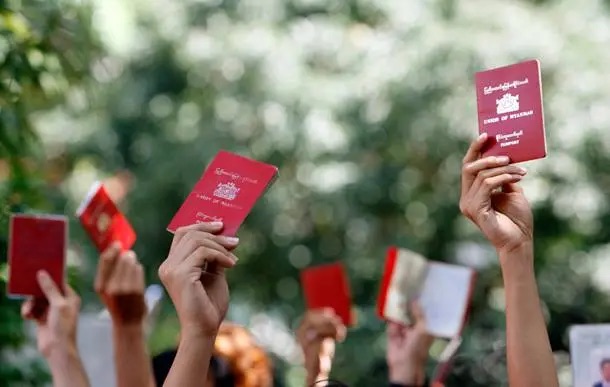
The day after the Moscow meeting, on 19 August 2026, an announcement went out: passport extensions would no longer be available to Myanmar nationals living in Thailand. Anyone who needs to renew now has to go back into the country to do it.
On its face, that reads like ordinary bureaucracy, the kind of policy tweak governments make all the time. But to anyone who understands what's happening on the ground, it reads very differently. Thailand is home to an enormous number of Myanmar nationals, workers, students, whole families who left after the coup and rebuilt their lives just across the border, close enough to still feel connected to home, but far enough to be safe. For years, renewing a passport without setting foot back in Myanmar was one of the last pieces of normalcy they had left.
That option is gone now. Going back to "extend a passport" is, for many, effectively a one-way trip. Once someone crosses back in, there's no guarantee they'll be able to leave again, not because any law explicitly stops them, but because of what's waiting at checkpoints, recruitment offices, and the border itself. The timing lines up too neatly with the Russia deal to be a coincidence. The military needs men, and a passport rule that quietly funnels people back across the border, dressed up as paperwork, is one of the cleanest ways to get them without ever calling it a draft.
Cutting off the money
A week after the passport announcement, the second piece fell into place. On 28 August 2026, the junta announced that Myanmar banking apps could no longer be used from outside the country. Any IP address tied to a foreign location was blocked outright, effective the following day.
People tried the usual workaround, VPNs, and the junta responded by blocking those too, one at a time, as each one got identified.
This hit harder than it might look from the outside. A large share of the informal money-changing system that Myanmar nationals abroad depend on runs through agents who use these exact banking apps to move currency back and forth on someone's behalf, converting kyat to baht or dollars and back again. It isn't a formal exchange system, but for a population largely shut out of traditional banking, it's the system that actually works. With the apps now restricted to VPN access, and those VPNs being picked off one by one, that channel is closing fast.
Once it's gone, there's no exchange left. Money earned or held outside the country becomes money that's effectively trapped there. Money inside stays locked inside. Families abroad who used to send support home, and families at home who depended on relatives working overseas, are both left with fewer and fewer ways to move what they have.
Three moves, a week apart: a troop deal, a passport rule that pulls people back across the border, and a banking lockdown that seals off the money. On their own, each one could be waved away as a routine policy shift. Together, they look like something else entirely, a coordinated tightening of the grip, timed almost to the day.
Distraction by design
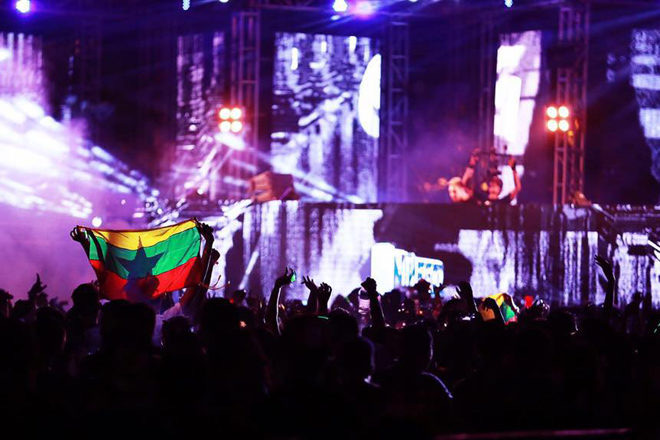
Alongside the pressure, the junta has been leaning harder into another strategy: distraction. Party culture and EDM events have been popping up more and getting pushed harder, aimed squarely at teenagers and young adults, the exact demographic most at risk of conscription, and the exact demographic the junta most needs to keep from organizing. The pitch, in effect, is that drinking, drugs, and partying can help people "lessen their suffering," a phrase that sounds almost caring on the surface and is anything but underneath it.
Celebrities and influencers have been brought in to help sell the idea that things are getting better, that life is returning to something normal. Big public events are staged to show the military in the best possible light, with the kind of polish designed to look effortless. Films are being produced to highlight the military's "positive" contributions, a steady stream of content built to reshape the narrative before anyone else can tell it.
Meanwhile, real reporting on bombings and civilian deaths gets buried under this wave of curated content, or blocked outright before it can spread. When the loudest voices online belong to famous faces at parties and events, it becomes easier, especially for younger people, to lose track of what's actually happening just outside the frame. The suffering doesn't stop. It just gets harder to see, drowned out by noise that was designed, deliberately, to drown it out.
The pattern underneath it all
Looked at individually, each piece seems unrelated: a foreign policy meeting, an immigration rule, a banking regulation, a cultural trend. Looked at together, with the timing lined up, the picture changes completely. A deal is struck abroad for tens of thousands of soldiers. A day later, the door home quietly becomes a one-way door. A week after that, the money that might have helped people leave, or survive if they stayed, gets locked down too. And running underneath all of it, a steady current of parties, films, and famous faces working to keep people from noticing, or caring, or resisting.
It isn't one policy. It's a system, built piece by piece, to squeeze the people of Myanmar from every direction at once, while handing them just enough distraction to look somewhere else.
Note: This account reflects the perspective and information available to the source at the time of writing. Names, dates, and figures should be independently verified before publication.