Two bombs at lunchtime: how Myanmar's junta is waging an air war on Rakhine's markets
At noon on 28 September, a military jet bombed the main wholesale market in Kyauktaw, killing at least 49 people. Why the junta keeps fighting Rakhine from the air.
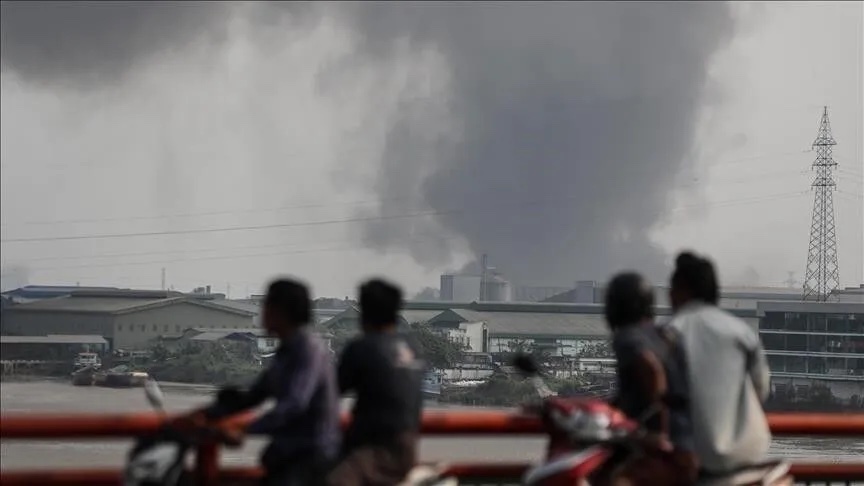
Noon in Kyauktaw
Monday, 28 September, started like any other market day in Kyauktaw, a river town on the Kaladan in northern Rakhine State. Around noon, at the busiest hour of the day, a Myanmar military jet flew overhead and dropped two bombs. One landed near the bridge. The other came down on the town's main wholesale market, right in the middle of the traders, shoppers, and porters who were there to do what they do every day.
By the next day, the Associated Press had counted at least 49 dead and 58 wounded, 22 of them in critical condition. The Arakan Army, which controls the town, put the number at 50 or more, and said children and pregnant women were among the dead. Buildings burned. Vehicles were left twisted and wrecked. Part of the bridge was gone.
"This is one of the most severe airstrikes in Rakhine," Wai Hun Aung, a senior rescue official, told the AP. In a state that has seen as much as Rakhine has, that says a lot.
A market, not a front line
The people who died that day weren't soldiers. They were vendors, shoppers, passers-by, and porters unloading cargo. The market was the main wholesale hub for the whole region, the place traders came to from all over Rakhine. It dealt mostly in dry goods, beans, dried fish, chili, along with fuel.
To understand why that matters, you have to understand what Rakhine has been living through. Since fighting resumed in late 2023, the state has been squeezed by a military blockade. In April, the junta took a key junction in Magway Region and cut off the main land route into the state. Within weeks, traders in Kyauktaw watched wholesale prices jump sharply. Today, basic goods in Rakhine cost up to five times what they do in central Myanmar, and the World Food Programme says 57% of families can't afford basic food.
So the bombs didn't just hit a crowd. They hit the one place where a starving state's supply chain was still holding together.
Why the junta fights from the air
Rakhine has largely slipped out of the military's hands. Since launching its offensive in November 2023, the Arakan Army has taken 14 of the state's 17 townships, plus neighbouring Paletwa in Chin State. It is one of the best-armed ethnic forces in the country.
On the ground, the junta has been routed or besieged across much of the region. In the air, it faces almost nothing. The resistance has drones, rifles, and captured artillery, but no fighter jets and very little air defence. Aircraft are the one advantage the military still holds outright, and it keeps using that edge against towns it can no longer take by land.
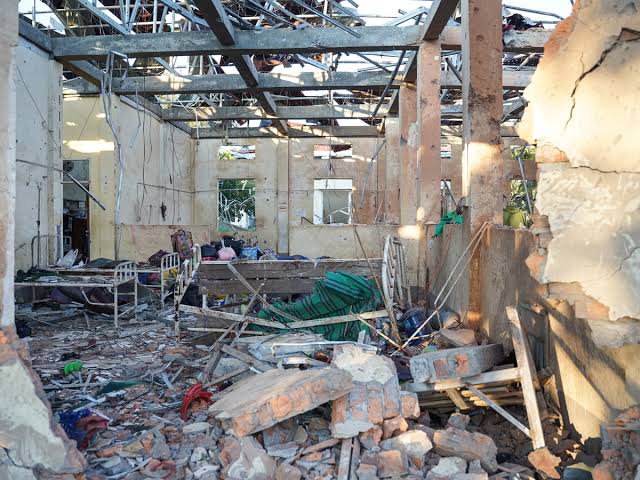
Kyauktaw knows this pattern well. In September 2025, an airstrike on two boarding schools in the township's Thayet Thapin village killed at least 18 people, most of them students. In December 2025, a strike on the hospital in neighbouring Mrauk-U killed more than 30.
Analysts see a second purpose behind it. Security analyst Sai Kyi Zin Soe told Radio Free Asia that the strikes are part of a wider campaign of military, political, and economic pressure meant to push the AA into peace talks on the junta's terms, and to scare civilians away from accepting AA rule. The AA says that between April 21 and September 30, the military kept inviting it to talks while killing more than 130 civilians in its territory.
If that's the strategy, it doesn't seem to be working. "The peace process requires trust," said Thar Tun Hla, chairman of the Arakan National Party. Bombing civilians, he argued, destroys exactly that. The AA has vowed to identify those responsible and retaliate.
The fuel behind the bombs
The air war runs on its own supply chain. In January, Amnesty International reported that Myanmar imported 109,604 tonnes of aviation fuel in 2025, up 69% from the year before, through shipments set up to slip past sanctions. Rights groups have argued for years that cutting off jet fuel is the most direct way to keep the bombers on the ground.
An economy already on its knees
The strike lands on an economy that was already struggling to stand. The World Bank estimates Myanmar's GDP shrank by about 2% in the fiscal year to March 2026. A fuel shock tied to the conflict in the Middle East then dragged the growth forecast down to 2%. Output, sales, and profits are still well below where they were before the coup, and inflation has run close to 30% in recent years.
For Rakhine, those national numbers don't come close to capturing the pain. Fuel and fertilizer are now out of reach for many rice farmers. Around half a million people in the state have been displaced. Across the country, the conflict has killed more than 100,000 people since the 2021 coup, according to ACLED.
What comes next
UN Secretary-General António Guterres condemned the attack. The UN human rights office called it one of the deadliest airstrikes in Rakhine since the coup, and Fortify Rights said it could amount to a war crime. The military hasn't commented, though it has long insisted it only strikes legitimate military targets.
On the ground, the fighting keeps moving. The AA is pushing toward junta-held Sittwe and Kyaukpyu, while government forces press in from Chin State, Magway, and Ayeyarwady. Residents say the airstrikes haven't stopped.
A sky that stays open
For Kyauktaw's traders, the lesson of 28 September is a grim one. The junta has lost the ground war across most of Rakhine, but it hasn't lost the sky. And as long as it can't win on land, it will keep reaching for the one weapon it still controls, aimed not at front lines, but at the places where ordinary people gather to buy, sell, and survive.
As long as that holds, no market in Rakhine is ever really out of range.
Note: This piece draws on news reporting and figures available at the time of writing.